
The Crypto Fear and Greed Index has shifted back into neutral territory, marking a notable change in market sentiment after an extended period dominated by fear-driven positioning. The move suggests that extreme pessimism has eased across digital asset markets, with investors adopting a more balanced and measured outlook toward risk.
Sentiment indicators play a critical role in crypto markets due to the asset class’s sensitivity to psychology and momentum. Unlike traditional financial markets, where valuation models and earnings data often anchor expectations, digital assets are heavily influenced by crowd behaviour. The return to a neutral reading reflects a market that is no longer driven primarily by panic selling or euphoric buying.
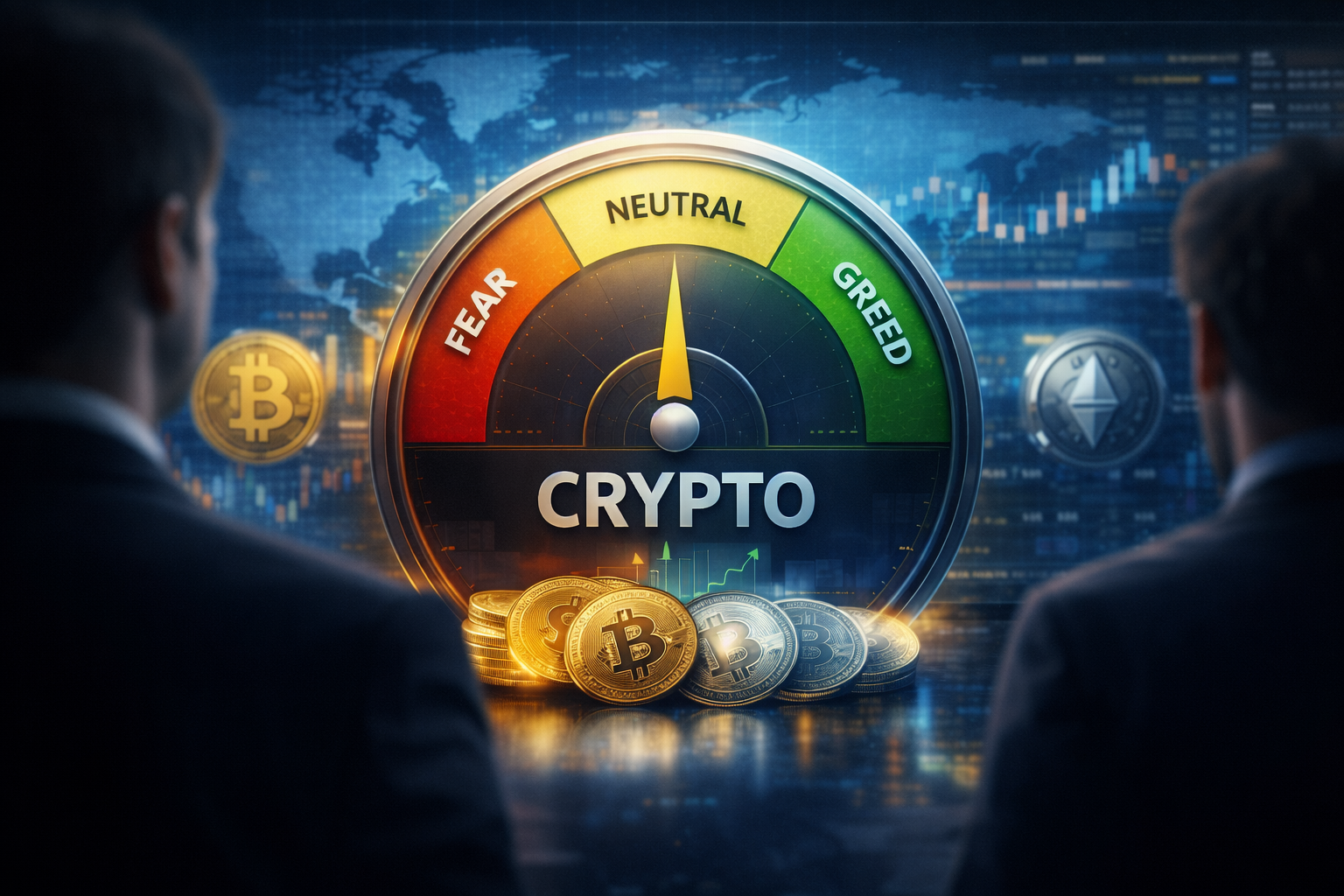
In recent weeks, crypto prices have shown signs of consolidation rather than aggressive directional movement. Bitcoin and other major cryptocurrencies have traded within defined ranges, suggesting that traders are reassessing positions rather than exiting the market entirely. This stabilisation aligns closely with the Fear and Greed Index’s move away from extreme readings.
The index itself aggregates multiple data points, including volatility, trading volume, social media activity, market momentum, and dominance metrics. When fear dominates, investors tend to sell aggressively, often exacerbating downward price moves. Conversely, periods of greed are typically associated with rapid rallies and increased leverage. A neutral reading indicates a temporary equilibrium between buyers and sellers.
Bitcoin, as the market’s bellwether asset, has played a central role in shaping current sentiment. While volatility remains elevated compared with traditional assets, recent price action has been more orderly. Sharp intraday swings have become less frequent, and liquidity conditions have improved across major trading venues.
Ethereum and other large-cap altcoins have followed a similar pattern. Network activity remains resilient, and on-chain metrics suggest continued engagement rather than capitulation. This has contributed to a broader perception that the market is entering a phase of consolidation rather than decline.
Analysts note that sentiment stabilisation often precedes decisive moves, though the direction is not always immediately clear. A neutral Fear and Greed Index reading does not necessarily signal the start of a bull market, but it does suggest that selling pressure has diminished. This can create conditions for accumulation by longer-term investors.
Macro factors continue to influence crypto sentiment. Interest rate expectations, global liquidity conditions, and regulatory developments all shape investor behaviour. While some uncertainty remains around monetary policy trajectories, recent signals have reduced fears of abrupt tightening, easing pressure on risk assets including cryptocurrencies.
Regulatory clarity has also contributed to improved sentiment in certain jurisdictions. Progress toward clearer frameworks for exchanges, custodians, and institutional participation has reduced tail-risk concerns that previously weighed on the market. Although regulatory risk has not disappeared, it is no longer the dominant narrative.
Institutional activity remains a key variable. Flows into regulated crypto products and exchange-traded vehicles have shown signs of stabilisation, reinforcing the perception that professional investors are maintaining exposure rather than exiting the asset class. This has helped anchor sentiment during periods of price consolidation.
Retail participation, while more subdued than during peak bull cycles, has also become more measured. Social media indicators suggest a decline in speculative frenzy, with discussion shifting toward longer-term adoption themes rather than short-term price targets. This change in tone aligns with the neutral sentiment reading.
Volatility remains an inherent feature of crypto markets, but the current environment appears less emotionally charged than in recent months. Traders are increasingly focusing on technical levels, macro correlations, and on-chain data rather than reacting impulsively to headlines.
Historically, transitions from fear to neutral sentiment have often marked inflection points in market structure. In some cases, they have preceded sustained recoveries. In others, they have acted as pauses before further declines. The key difference lies in broader macro conditions and follow-through in volume and participation.
At present, trading volumes suggest cautious engagement rather than aggressive positioning. This indicates that while fear has subsided, conviction remains limited. Market participants appear willing to wait for clearer signals before committing significant capital.
Bitcoin dominance has remained relatively stable, reflecting balanced interest across major assets. This suggests that the market is not yet rotating aggressively into higher-risk altcoins, a behaviour more commonly associated with periods of strong optimism.
From a risk management perspective, neutral sentiment often encourages more disciplined trading behaviour. With extreme emotions subdued, investors may be better positioned to assess fundamentals, technical structures, and macro trends objectively.
Looking ahead, upcoming macroeconomic data and central bank communication will likely play a significant role in shaping sentiment. Crypto markets remain sensitive to changes in global liquidity and risk appetite, and any unexpected developments could quickly alter the emotional landscape.
Technically, several major cryptocurrencies are trading near key support and resistance zones. A sustained break in either direction could shift the Fear and Greed Index away from neutrality. Traders are closely monitoring these levels for confirmation of the next trend.
The broader implication of the index’s move is that crypto markets may be entering a transitional phase. Rather than reacting to extremes, investors are reassessing the asset class’s role within diversified portfolios. This maturation of sentiment, even if temporary, reflects the market’s evolving structure.
While uncertainty remains, the return to neutral sentiment represents a meaningful reset. It suggests that the market has absorbed recent shocks and is recalibrating expectations. Whether this leads to renewed growth or prolonged consolidation will depend on a combination of internal market dynamics and external macro forces.
For now, the neutral Fear and Greed Index serves as a reminder that crypto markets are not driven solely by price but by perception. Understanding sentiment remains essential for navigating an asset class where psychology and fundamentals are deeply intertwined.


